Music Etcetera

This blog is about my music interests and other things that command my attention from time to time.

Saturday, February 21, 2009

The Blues Impulse

Heartaches by the Number is a great book!

The book is musicologists and cultural critics David Cantwell and Bill Friskics-Warren's list of their 500 favorite country records of all time, giving for each record their reasons why that record made their most-exalted list.

For #103, "Oh Lonesome Me," a record that went to #1 on the country charts for Don Gibson in 1958 and reached #7 pop, they say:

... Gibson [who was white] was ... a terrific and highly nuanced singer, one whose phrasing evinces a deep affinity with what [African American author] Ralph Ellison calls "the blues impulse." The "impulse to keep the painful details and episodes of a brutal experience alive in one's aching consciousness, to finger its jagged grain, and to transcend it, not by the consolation of philosophy but by squeezing from it a near-tragic, near-comic lyricism."


OK, that's admittedly a bit on the pompous side of profundity ... except that it's true, so true. There is a deep interpenetration of black and white styles of music in America. And the reason is that the best American music — jazz, blues, black gospel, soul, R&B, rock 'n' roll, white gospel, bluegrass, country & western, etc. — has its roots at one and the same time in not one but two once-suppressed American subcultures.

We all know that the "blacker" styles of music in that list above stem from the African American experience, but we might have to squint a little to recognize that the "whiter" styles all derive from the music of people that have long been derogated as hillbillies and white trash.

The "old-time" and stringband music of Appalachia, itself a descendant of what we now call the "folk" music of the British Isles, was incubated in the mountain areas where the Scots-Irish, despised by more "civilized," more "religiously correct" white colonists, concentrated.

Scots-Irish music and culture spread all over America in post-colonial days, even if the original Appalachian mountain dwellers kept to their own isolated ways. When Bill Monroe, the Father of Bluegrass, grew up in Rosine, Kentucky, in the early 20th century, he wasn't strictly speaking a hillbilly. But culturally, he was. When he invented bluegrass music in the late 1930s and 1940s — or helped invent it, as some purists insist — he channeled the old-time fiddle and stringband, not to mention church and gospel, music of his younger days into a higher key, fooled around with its "straight" tonalities, sped it up, and (most importantly, in my view) melded it with the African American blues he had also absorbed as a youth. If you don't believe me, listen to one of his signature tunes, "Muleskinner Blues," #158 in Heartaches by the Number (and Dolly Parton's remake is #159):


(That's from an appearance by Bill Monroe and the Blue Grass Boys at a festival on the National Mall in Washington, D.C., on January 18, 1993. Monroe died September 19, 1996, four days shy of his 86th birthday.)

Now that we have a president who is African American but also white on his mother's side, and now that we face an economic downturn that looks to be heading in the direction of The Great Depression Revisited — with its potential to set group against group — I think it's appropriate that we become a little more aware of the intermingled heritage we all share.

Labels:

Wednesday, June 27, 2007

The Mississippi Delta

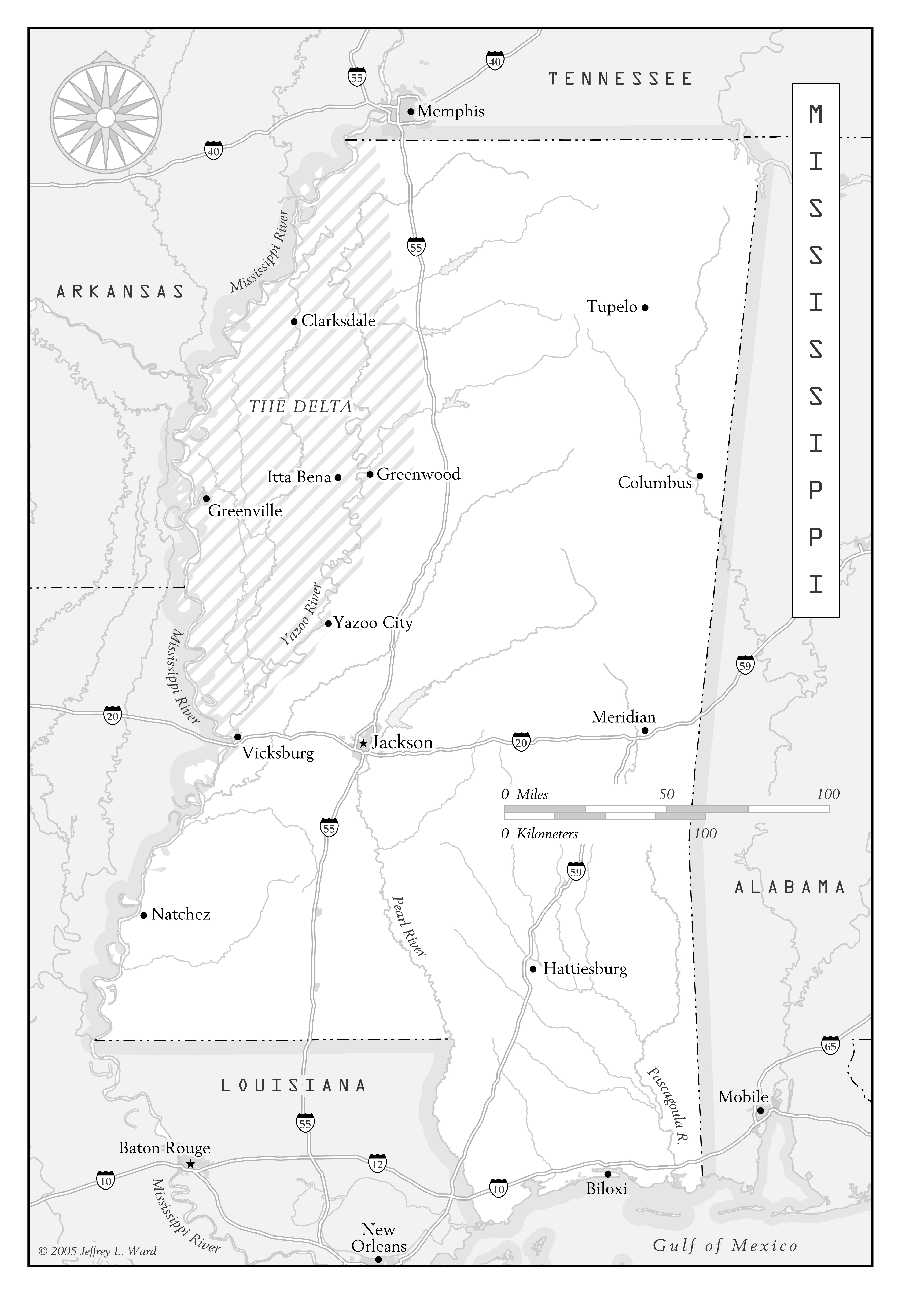
You often hear the Mississippi Delta said to be the birthplace of the blues. But where is it? Here is a map that answers that question:


The map reveals that the Mississippi Delta is not really a river delta at all. It is, in fact, an alluvial plain between the Mississippi River and the Yazoo River to the east. An alluvial plain is basically the site of a former river delta, while the river that originally formed it has extended itself — in this case southward to Baton Rouge and then southeast to New Orleans and the actual delta of today's Mississippi River.

In that alluvial plain, flooding distributes the silt that comes down the river evenly over a broad flood plain, forming a very flat land that is wonderful for growing crops — cotton, in this case.

African slaves once picked and ginned the cotton of the Mississippi Delta. Their descendants gave birth to the blues in the late 19th and early 20th century.

Meanwhile, other black slave descendants in New Orleans to the south had already created other music styles that likewise amalgamated African and European musical influences, just as the early blues in the Delta did. These New Orleans styles were the building blocks of, first, ragtime, and later on, jazz.

Labels:

Sunday, June 24, 2007

Singing the Blues

Last night, uncertain what type of music I felt like listening to, I aimed my digital cable-TV box at the "Music Choice" stations and settled for the Show Tunes channel. Good music ... but after several songs it began to pall. It hit me that all the music I was hearing was conspicuously "white folks' music." It lacked "soul."

Oh, there were one or two exceptions in the playlist I was getting, numbers that had a "rock" style and could therefore be imagined as a distant cousin to "black folks' music." But for the most part, the Show Tunes being played were as square as square could be.

They were giving me a headache. So I changed to the Gospel channel.

I have never listened to much gospel, for whatever reason, so I was surprised to find that the funky gospel sound going in my ears very quickly cured my headache!

I also realized how close gospel, at least as performed by African Americans — there is also a white gospel sound — is to the so-called soul music I listened to in the 1960s and thereafter: Sam and Dave, Wilson Pickett, et al. Intellectually, I already knew "soul" had emerged as a secularized, de-sanctified gospel, but listening to real gospel as it is performed today really brought that fact home to me. Owing to poor hearing in the upper registers, I can't really pick up the lyrics of a lot of the music I hear, so it was hard for me to tell these songs were praising Jesus rather than extolling the singer's own true love.

After getting "sanctified" by the gospel sound, I decided it was time to get down with some blues, so I popped my "Blues Brothers" DVD in the player. The songs on the soundtrack, as I well knew, were not just "blues" numbers. There were also soul golden oldies and R&B classics from the recent African-American musical past. The songs John Belushi, Dan Aykroyd and company were spotlighting came from a repository selected by the film's creators that carefully avoided making fine distinctions among the various African American musical genres.

They were all funky. They were all bluesy. They all had soul.


What is it, I wondered, about funky, bluesy, soulful music that gives it its ability to cure a headache brought on by too much musical "whitebread?" A little bit of research shows me that the answer is not all that simple.

Furthermore, most of the sources I have found online tend to get real intellectual about the history, sociology, psychology, etc., of African American music. As Jake and Elwood Blues would say about that ... well, what they would say can't be put in a family-oriented blog like this one. Just play the freakin' song, their basic attitude would be. When you're "on a mission from God," you don't have time for intellectualities.

Still, it's patently obvious that this music has to have "plenty of rhythm" and "plenty of jive," to lift phrases from one of the songs that gave Ricky Nelson soul in the 1950s, "Be-bop Baby." A musicologist would point out how "syncopated" the rhythms are, meaning that beats are accented that wouldn't "normally" be accented.

African American music also features notes that don't come from the European DO-RE-MI diatonic order — not even the minor-scale version thereof, in which MI is flatted by a semitone. There is instead a note between MI and MI-flat, a "blue note" that can't be played on a piano unless you shift between two neighboring keys.

That in effect "bends" the note being played ... which is fine, because there are a lot of "bent" notes in African American singing and instrument playing. I believe the technical term is "melisma," and if you want to know how it sounds, listen to anything by Mariah Carey.

In fact, I recently watched a movie called "Songcatcher" about an early-20th century musicologist's journey into the Appalachian hill country to record the pure folk music there — music that came to America with early Scots and English settlers and hadn't changed for several centuries. It also involved alternate, non-diatonic tonalities and the bending of vocal notes. It was different from African American music, mainly because of its rhythms, I think, but it had those features in common.


As a result, it's not hard to see how its descendants — country 'n' western, bluegrass, Texas swing, etc. — could mix so easily with the musical styles of African Americans to make jazz, Big Band swing, rockabilly, and rock 'n' roll. You might note that all these genres originated with the music of peoples who were marginalized — black slaves and their descendants; hillbillies, dirt farmers, and Southern so-called "white trash."

That's why the white folk tunes captured by the fictional heroine of "Songcatcher" (or those first recorded by the very real Alan Lomax) and the black blues first recorded in about 1920 by the likes of Ralph Peer, of OKeh Records, belong together in the broad category, "early soul music."

It's why it makes sense that "Songcatcher" has a cameo by African American blues notable Taj Mahal as a member of the otherwise all-Caucasian music culture of the film.

It's why it makes sense that Taj Mahal, born Henry Saint Clair Fredericks, comes from a musical family wherein his father was a jazz pianist/composer/arranger of Jamaican descent, while his mother was a schoolteacher from South Carolina who sang gospel.

All these — including the "hillbilly" music of "Songcatcher" — are types of music that have soul. Even "white folks' music" can sing the blues.

Labels: